
Key concepts and key works
Mental Health Precarity and De Twee Levens van Penelope
Written by: Sara Ligtvoet, Yael Prenger
Originally Published June 2025
Introduction
Precarity manifests across various life aspects, with this entry focusing on mental health. According to the American Psychological Association, “precarity refers to an overriding state of vulnerability, insecurity, lack of power and agency, and sometimes, existential threat.” This fragile state can lead to mental health issues, often through stress. Excessive stress overwhelms the body, possibly causing health problems like heart or muscle issues, and psychological conditions such as Post-Traumatic Stress Disorder (PTSD), depression, or anxiety. Living in uncertain or unstable situations intensifies these effects over time, contributing to mental health decline.
However, mental health precarity is not experienced or understood uniformly across contexts. In French-speaking settings, psychological suffering is often framed as part of précarité psychique, meaning the intersection of social marginalization and mental illness. The French national health authority (Haute Autorité de Santé) describes this relationship as a double peine, or “double penalty,” in which mental health issues and social exclusion reinforce each other, creating a vicious cycle of vulnerability and under-treatment (“Accompagner les personnes en situation de grande précarité”). This cycle is especially present in private life, where emotional instability often remains invisible.
Similarly, in the German-speaking world, growing attention has been paid to how Prekarität, including irregular work, unstable housing and insecure relationships, is a major risk factor for mental health, especially among women. As Amanda Ioset – secretary general of ARTIAS (an association involved in social action Switzerland) – explains, people in precarious life situations face a higher risk of psychological conditions, but also tend to receive less psychological support, creating a loop of increasing vulnerability (Prekarität: ein Risikofaktor für die mentale Gesundheit).
Gender is a central factor in how mental health precarity is experienced and addressed. Women report higher rates of anxiety and depression, while men are more often affected by externalizing conditions like substance abuse and antisocial behaviour (“The Gender Gap in Mental Health”). Yet help-seeking itself is shaped by gender norms: women are more likely to seek support, while men are often discouraged from expressing emotional distress, due to stereotypes around strength and independence (“The Gender Gap in Mental Health”). These norms compound psychological strain in different ways — generally, women may internalize suffering and overextend themselves in care roles, while men may suppress their symptoms until they escalate.
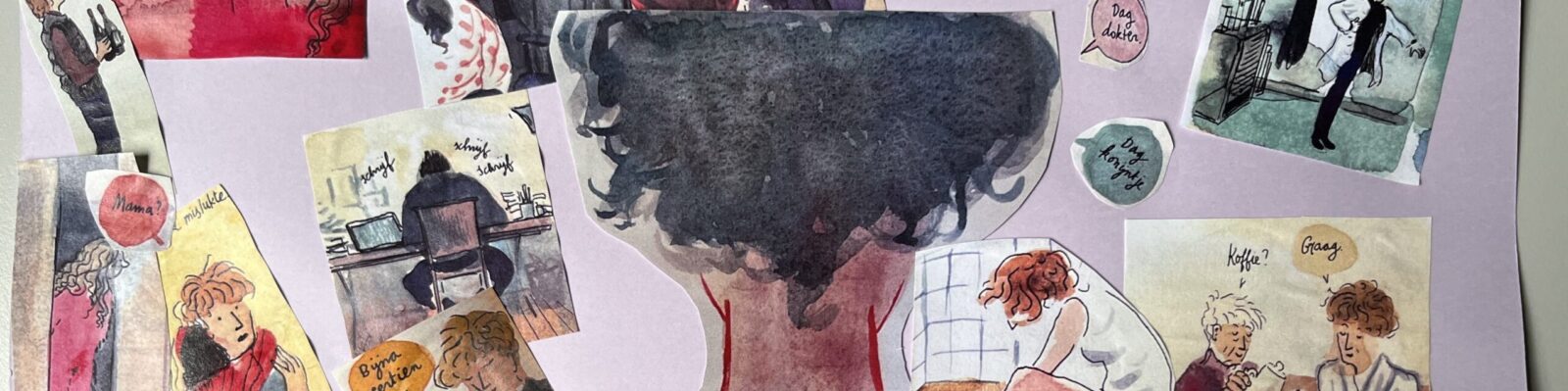
To explore this further, this entry analyses De twee levens van Penelope, a novel by Judith Vanistendael. Penelope, a surgeon who works in war-torn Aleppo and lives in Belgium, faces intense trauma at work that gradually infiltrates her personal life. Through the story of her fractured relationships, embodied stress, and the symbolic ghost that haunts her, the novel offers a poignant portrayal of mental health precarity across both work and life. This analysis unfolds in two parts, the work context and the life context, drawing on French and German cultural framings to examine how gendered expectations, trauma, and instability shape psychological vulnerability across borders.
Work Precarity
In De twee levens van Penelope, Penelope works as a surgeon in Aleppo and Brussel. In Aleppo she works 16 hours a day in the chaos of the war, between the explosions, dust, screaming people and broken bodies (Vanistendael 34, 78). Humanitarian workers are often exposed to various physical and emotional hazards; safety risks, unpredictability of humanitarian work, and organisational stressors were cited as significant contributors to mental health challenges. The book shows this in the illustrations, both the physical hazards, like the ongoing war, and the emotional hazards, like losing a patient. The book shows an operation on a girl, about the age of her daughter, who dies at the operating table (Vanistendael 13-22).
When she comes home, she discovers that for the first time, the ghost of the girl she lost, has come with her in her bag (Vanistendael 40). The ghost mainly stays in her bed, but when she goes to her work in Brussels, she discovers the ghost has come with her (pp. 68, 73). We also see clearly that the experience of losing her patient was traumatic as the memory painted in the form of a ghost of her patient follows her through the rest of the story. This is also supported by research on trauma which found high rates of depression and PTSD observed among aid workers.
And in addition to these risks that come with the profession, female aid workers face distinct security challenges, which are often rooted in cultural norms, gender roles, and the high prevalence of gender-based violence in crisis areas (Greenway et al.). It seems like women experience more anxiety and depression, but this is possibly due to women reporting struggles more often, like how Penelope instantly goes to see a psychologist and is open to her about her struggles throughout the book (Vanistendael 72-73, 96-97, 104-105, 114-115). To cope with all of this, more men than women turn to unhealthy coping strategies – anger, alcohol, drugs, gambling and more – to deal with mental health issues. (“What Coping Mechanisms Do Men Really Use to Stay Mentally Healthy?”) Women reported that emotional support was used significantly more frequently than men (Kelly et al.). This could explain how being open to professional help and talking about experiences with close relatives can help Penelope cope. She doesn’t talk much about it but also doesn’t shut others completely out when the topic comes up. When Otto asks about her scars, she does admit that she scratches them open when she is stressed, for example ( Another study suggested a statistically significant difference in the analysis of venting, finding this more in women than in men. This seems visible in quickly reaching out for help, for example in the form of psychotherapy.
Life Precarity
As the boundaries between war and home collapse, the ghost comes into her life. She know the ghost doesn’t exist, yet the ghost persists, even appearing at Christmas: “Are you back there now? I had hoped you were finally gone.[1]” (Vanistendeal 127). The ghostfunctions as a powerful symbol of unprocessed trauma, showing how emotional wounds from her work haunt her personal life.
This haunting coincides with a profound emotional disconnection at home. Penelope feels replaced, unnecessary: “No one is waiting for me.” (Vanistendael 26). Her family – Otto and their daughter Helena – have developed routines in her absence, continuing life without her (Vanistendael 77). Coming home becomes harder each time. She reflects, “I disappear and I appear.” (Vanistendael 27), signalling a loss of personal continuity. Her presence in the domestic sphere becomes spectral — physically there, but emotionally displaced.
This growing disconnect is sharpened by her struggle to reclaim her role as a mother. Helena wants her home, whispering, “I don’t sleep when you’re gone.” (Vanistendael 53). Yet Penelope cannot be both the ideal mother and the committed caregiver abroad. Otto, who has taken over most of the parenting, offers little understanding. His suggestion “Isn’t it about time to quit?” (Vanistendael 61) underscores her isolation and intensifies her internal conflict. The weight of her emotional absence, coupled with guilt and external pressure, destabilizes her sense of self.
Like the idea of précarité psychique (mental health precarity) is increasingly used to describe the psychological suffering that arises from marginalization, instability, and isolation, the “double peine” is especially evident in Penelope’s homecoming: her personal life no longer offers safety but becomes another space of emotional uncertainty. As French reporter Guillemette Jeannot describes in her coverage of mobile psychiatric units for precarious populations, “many people suffer in silence, caught in a vicious circle of poverty and psychological distress” (Jeannot). Though Penelope is not materially poor, she shares this condition of silent suffering, gradually pushed out of her own family structure. Her care work unacknowledged and her internal struggles invisible to those closest to her.
In German discourse, Penelope’s experience would likely be categorized as Erschöpfung (emotional exhaustion) or Burnout terms that describe the depletion of energy and sense of self under sustained emotional strain. Penelope’s dual life, with public heroism abroad and quiet erasure at home, reflects this very dynamic.
Although mental health care exists across all countries, cultural norms strongly influence access and expression. Women are more likely to seek psychological help but are also socialized to internalize distress and downplay their symptoms. As Coveney notes, therapy and vulnerability are still gender-coded as feminine and this coding affects both stigma and care pathways (Coveney). Penelope embodies this contradiction: she reaches out to her therapist, but underplays her trauma, saying only that she is tired. Her coping remains private, embodied, and unresolved.
Conclusion
Mental health precarity is not confined to professional settings or extreme environments. In De twee levens van Penelope, trauma bleeds into daily life — into bedrooms, conversations, and family routines. The ghost that follows Penelope is more than a symbol of trauma; it reflects how unprocessed psychological suffering becomes a constant presence, shaping relationships and disrupting identity.
Penelope’s experience illustrates that mental precarity is not just individual, but socially and culturally embedded. In Belgium, her inner instability remains largely invisible to those around her. French frameworks around précarité psychique stress how emotional suffering is often overlooked in domestic contexts, while German terms like Erschöpfung and Burnout speak to the exhaustion caused by sustained emotional demands and a lack of recognition. These cultural perspectives help contextualize Penelope’s psychological decline within broader gendered structures of care, silence, and endurance.
Throughout the novel, Penelope navigates a world in which strength is expected, vulnerability is downplayed, and emotional support is fragile. Her coping — understated, embodied, and semi-private — mirrors how women are often taught to internalize distress rather than articulate it. Though she seeks help, she struggles to name her pain.
Ultimately, Penelope’s story shows that mental health precarity is not just a professional risk — even more, it’s a deeply personal, gendered experience. It follows her home, fractures her relationships, destabilizes her role as a mother, and settles in her body. French and German perspectives on précarité psychique and Erschöpfung help illuminate the socio-cultural dimensions of this experience. Penelope reveals a transnational reality: women navigating trauma, guilt, and invisibility in systems that ask them to give everything, while healing almost nothing in return.
Bibliography
(Alphabetical & Per Language)
General
Blustein, David L., et al. “The Psychology of Precarity: A Critical Framework”. American Psychologist, 2024. APA PsycNet, https://doi.org/10.1037/amp0001361.
Coveney, Sophia. “The Gender Gap in Mental Health”. News-Medical, 31 Jan. 2022, https://www.news-medical.net/health/The-Gender-Gap-in-Mental-Health.aspx.
Greenaway, Liddy, et al. Research Study: The Status of Frontline Humanitarian Workers. 2024, https://interagencystandingcommittee.org/sites/default/files/2024-12/Status%20of%20frontline%20workers_Research%20Study.pdf.
Kelly, Megan M., et al. “SEX DIFFERENCES IN THE USE OF COPING STRATEGIES: PREDICTORS OF ANXIETY AND DEPRESSIVE SYMPTOMS”. Depression and Anxiety, vol. 25, no. 10, 2008, pp. 839–46. PubMed Central, https://doi.org/10.1002/da.20341.
Vanistendael, Judith. De twee levens van Penelope. Oogachtend Scratch, 2019.
“What Coping Mechanisms Do Men Really Use to Stay Mentally Healthy?” CBHS Health, https://www.cbhs.com.au/mind-and-body/blog/what-coping-mechanisms-do-men-really-use-to-stay-mentallyhealthy. Accessed 24 May 2025.
French
“Accompagner les personnes en situation de grande précarité présentant des troubles psychiques”. Haute Autorité de Santé, https://www.has-sante.fr/jcms/p_3488843/fr/accompagner-les-personnes-en-situation-de-grande-precarite-presentant-des-troubles-psychiques. Accessed 23 May 2025.
Jeannot, Guillemette. “REPORTAGE. Santé mentale et précarité, ‘un cercle vicieux’ : des soignants vont à la rencontre de personnes marginalisées souffrant de troubles psychologiques”. Franceinfo, 18 Apr. 2022, https://www.franceinfo.fr/sante/psycho-bien-etre/sante-mentale/reportage-sante-mentale-et-precarite-un-cercle-vicieux-des-soignants-vont-a-la-rencontre-de-personnes-marginalisees-souffrant-de-troubles-psychologiques_5034966.html.
German
Ioset, Amanda. Prekarität: ein Risikofaktor für die mentale Gesundheit. https://www.zeso-magazin.skos.ch/de/artikel/prekaritaet-ein-risikofaktor-fuer-die-mentale-gesundheit. Accessed 23 May 2025.
“Psychische Erschöpfung”. Hilfe und Information – Oberberg Kliniken. www.oberbergkliniken.de/symptome/erschoepfung. Accessed 06 June 2025.
[1] Own translations