
Key concepts and key works
Female Rage in Amalia
Babs van Es, Tamarah Sies and Dylan Veerbeek
Introduction
In a previous Key Concept, we have discussed the concept of mobility in three different languages and connected this to the 2018 film Roma, by Alfonso Cuarón. In this Key Concept we will delve further into mobility by exploring the concept of Female Rage across the same languages as the previous Key Concept. Female Rage can be considered an emotion, as it is something that makes you “move” or that you are “moved by,” and in this way it is connected to mobility. The concept of Female Rage will be connected to the (originally) French comic book Amalia by Aude Picault. Since the literature is originally written in French, we will look into the concept of Female Rage in French as well.
Female rage in Italian context
In the Italian language, the concept of “female rage” has deep historical and cultural roots, although there is no exact Italian equivalent to the English use of the term. The most common translation is rabbia femminile (female anger), derived from the Latin rabia and connected to rabere, meaning “to rave” or “to be mad” (Treccani.it). The term is etymologically related to the English word “rabid.” Another expression is furia femminile (female fury), a stronger and more dramatic term derived from the Latin furia and furere, meaning “to rage” (Treccani.it). In Roman mythology, the Furiae (the Furies) were female spirits of vengeance, giving the term an archetypal association with righteous feminine wrath. A third translation could be ira femminile (female wrath), which is associated with female passion, violence, and intense emotional expression (Treccani.it). All these terms demonstrate how female anger in Italian culture has long been associated with emotional excess and instability rather than rational political resistance. However, in contemporary literary and political discourse, rabbia femminile is increasingly used to reclaim women’s anger as something legitimate rather than irrational or shameful.
Historically female anger was rarely legitimized as justified rage in Italy. Instead, it was frequently dismissed as isteria (hysteria), a term derived from the Greek and Latin word hystera, meaning uterus. Women’s emotions were therefore pathologized and interpreted as symptoms of bodily dysfunction, emotional instability, or “female madness”. Rather than being acknowledged as a valid response to oppression or injustice, female anger was often medicalized and ridiculed (Gittlen). This representation of female rage is deeply connected to regional and cultural stereotypes within Italy. A notable example is the term terrona, a derogatory word historically used to describe Southern Italian women as excessively aggressive, impulsive, and overly emotional (Treccani.it). The modern use of rabbia femminile therefore seems to represent an important cultural shift, reframing women’s anger as a political and human response to structural inequality, emotional exhaustion, and gendered oppression.
Where Female rage has long functioned as a tool of artistic and political subversion that through our eyes even have roots in Baroque art (Gittlen), nowadays it has evolved into a powerful socio-political movement as well as an important literary and political force as well as a popular cinematic theme.
Female rage in Dutch context
The literal translation of female rage in Dutch would be vrouwelijke woede. Just like in Italian, there is not just one word for it. An article by Mare Versteege, Fonkelend van Feministische Woede (Versteege, Studium Generale Universiteit Utrecht), states that women have a lot of reasons to be upset. Difference in salary, sexual intimidation and “the glass ceiling” (an invisible social and cultural barrier, keeping women and minorities from reaching high positions at workplaces), to name a few. The Dutch society labels angry women as emotional, hysterical and even as unstable.
Young girls are being taught to hide their anger. Even though anger can show its purpose at times, for example to fight injustice, it is also seen is as unladylike and unattractive. From a young age we are confronted with stereotypes concerning our gender. Our society has given signed gender roles to specific emotions, where boys are “angry” and girls are “sad” (Versteege, Studium Generale Universiteit Utrecht). This teaches children early on in life that some emotions are more or less appropriate for girls, creating a double standard. Where an angry man is seen as standing his ground, an angry woman is seen as not having her emotions under control (Versteege, Studium Generale Universiteit Utrecht). This type of “gendered upbringing” is usually not done as a deliberate choice, it can, however, cause negative developments and causes many debates within society (Endendijk, Sociale Vraagstukken).
Female rage in French context
The comic Amalia (2022), by comic book artist Aude Picault, is originally written in French. Even though French is not our field of study, it is an interesting perspective to look at, considering the comic is written by a French woman. Female rage seems to know different translations, two of them being la rage féminine and la colère féminine.
La colère féminine or la femme en colère translates to “the angry woman”. Where Dutch and Italian do not seem to have a specific term for “female rage”, this does seem to be the case in French. La rage féminine is supposedly used for women’s unfiltered anger towards society on topics such as injustice and sexism.
A French article, “Female Rage” Ou Rage Féminine : Qu’est-Ce Que C’est? by Maelys Berthout, on the painting ‘The reluctant Bride‘ from the French painter Auguste Toulmo, discusses women’s anger. It describes women’s anger as a very specific construct where women almost keep their anger silent and to themselves, even though they are raging inside. The question of what could be the explanation of this female rage is answered with the idea that women were being associated with being hysterical. This article also goes on to state that even to this day little girls are taught to behave in a certain way, where they do not make too much noise (Berthout, Femmeactuelle).
Female rage in Papiamentu context
On Curaçao, the concept of “female rage” exists socially and culturally, though it is not commonly framed through that exact terminology or through contemporary feminist discourse. Rather than functioning as a distinct category, women’s anger is embedded within social roles, family structures, and emotional expectations. Female rage therefore exists as a lived experience but is expressed through culturally specific language and practices rather than through a clearly named concept.
Papiamentu contains a nuanced vocabulary for describing emotional intensity and anger. The most common term is rabia, literally translated as “rage,” while bai rabiá means “to become angry” or “to get furious.” The term likely derives from Spanish rabia, which itself originates from Latin rabies, meaning fury, rage, or madness. The Latin verb rabere means “to rave” or “to be mad.” Another expression, rabia skèrpi, literally translated as “sharp anger,” combines rabia with skèrpi (“sharp”), likely derived from Dutch scherp, which traces further back to Proto-Germanic skarpa, meaning “cutting” or “pointed.” The phrase suggests not only anger itself but a form of bitterness of/ or speech capable of causing emotional wounds. These terms reveal the layered linguistic influences of Papiamentu and demonstrate how emotional experiences become embedded within language through colonial and cultural exchange.
Another term used for more intense anger is kólera, literally translated as “wrath,” “fury,” or “rage.” This word likely derives from either Portuguese or the Spanish cólera, which can refer both to anger and the illness cholera. Spanish cólera itself comes from Latin cholera, borrowed from Ancient Greek kholéra. The Greek term derives from kholē, meaning “bile.” This connection reflects the ancient medical theory of the four humors, in which excessive yellow bile was believed to produce anger and aggression. Therefore, kólera carries traces of historical ideas connecting emotional states to bodily processes. While contemporary speakers no longer consciously associate the term with these medical beliefs, the linguistic history remains embedded within the word itself.
Although these expressions are not specifically gendered, female rage on Curaçao can be understood through women’s social roles within the island’s historically matriarchal structures. Mothers and grandmothers frequently occupy central positions within households and are often expected to maintain discipline, emotional stability, and caregiving responsibilities. Within these roles, anger can become socially accepted when it serves protection or authority. However, women’s emotional exhaustion often becomes invisible when it extends beyond these accepted functions. Rage connected to caregiving burdens, emotional labor, or domestic responsibility is frequently interpreted as ordinary frustration rather than legitimate suffering.
This dynamic becomes particularly visible in the literary representation of Amalia (2022). The concept of female rage is reflected in her experience as she carries the overwhelming burden of reproductive and domestic labor. Amalia is expected to care for her child, maintain the household, support her husband within the comic, which seem to be in line with expectations for women on Curaçao.
All while continuing her professional responsibilities simultaneously. The accumulation of these expectations gradually becomes unbearable throughout the story, leading to emotional exhaustion and increasing expressions of anger. Yet her suffering remains largely ignored because it does not initially appear as a visible or medically recognizable form of distress, especially towards others.
The language itself reveals layers of African, Spanish, Dutch, Latin, Greek, and creole influences, demonstrating how emotional concepts evolve across histories of migration, colonization, and cultural exchange.
Amalia
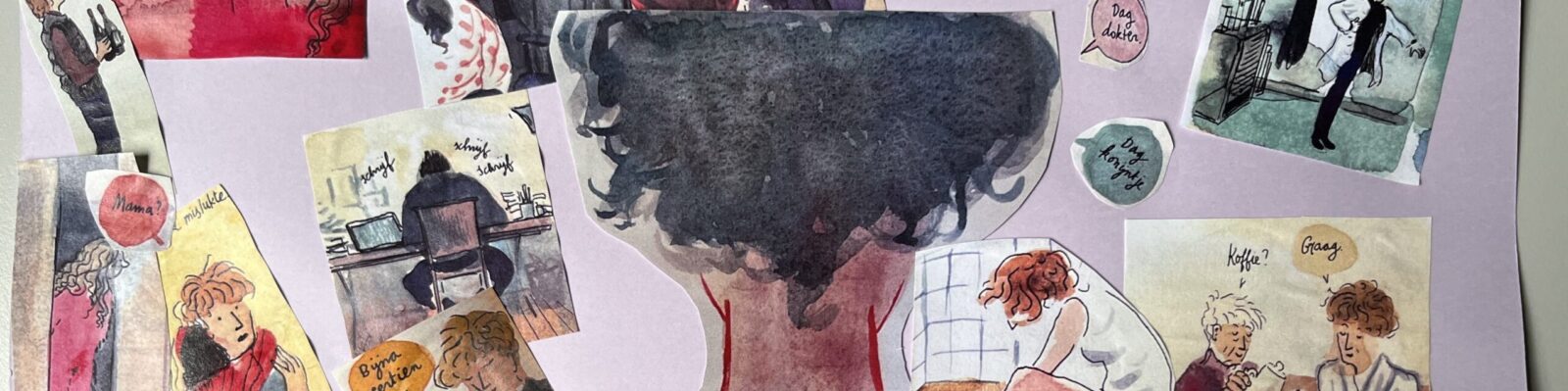
Amalia is a character in a graphic novel, by the same name. She is a wife, a mother and an employee, and throughout the story we see her trying to keep everything on track. Bringing her daughter to school, doing household chores like cooking and cleaning, supporting her husband, and going to work. All these roles take their toll on Amelia, we see her struggling and trying and eventually suffering from a burnout.
Female rage in Amalia
The concept of female rage is clearly reflected in the character of Amalia. She is expected to carry the full burden of reproductive and domestic labor: caring for her child, maintaining the household, supporting her husband, and continuing her professional responsibilities simultaneously. The accumulation of these expectations gradually becomes unbearable, causing her to lose patience and express increasing anger. However, her emotional exhaustion remains largely ignored because it is not considered a visible or legitimate form of suffering.
It is only when Amalia’s body physically collapses that the seriousness of her condition becomes recognized. This physical breakdown demonstrates how female suffering often needs to become materially visible before it is taken seriously by society. Her burnout is minimized because it lacks a concrete medical diagnosis or straightforward cure. As it isn’t a physical disease but a philosophical one. As a result, her exhaustion is trivialized, particularly by her husband, who assumes that a short period of rest should be sufficient for her recovery. Through Amalia, female rage emerges not as irrationality or hysteria but as a rational response to unequal emotional, reproductive, and domestic expectations. Her story transforms invisible suffering into something visible and undeniable, revealing how female rage can function as a political expression of exhaustion within structures that normalize women’s labor and emotional sacrifice.
Amalia’s experience therefore illustrates how female rage and exhaustion, especially when connected to reproductive care, emotional labor, and domestic responsibilities, are frequently dismissed until they become physically undeniable.
The literary representation of Amalia is politically significant because it transforms invisible female suffering into something visible and undeniable. By portraying female rage as a rational response to social inequality and emotional exhaustion, the narrative challenges traditional representations of women as irrational, unstable, or hysterical. The work therefore functions as a political tool that legitimizes female anger and forces society to confront forms of emotional and domestic labor that are often ignored.
Conclusion
In conclusion, the concept of female rage takes different linguistic and cultural forms across Italian, Dutch, French, and Papiamentu contexts, yet similar patterns emerge in the way women’s anger is perceived and regulated. Across all these languages, female anger has historically been associated with hysteria, emotional instability, or irrationality rather than being recognized as a legitimate response to inequality and oppression with which women are faced in day-to-day life within a patriarchal society.
Cultural expectations and gender roles often teach women from a young age to suppress or control their anger, even going as far as to call out these emotions as something un-womanly or hysterical, reinforcing unequal emotional standards. At the same time, contemporary discussions increasingly seem to reclaim female rage as a valid and political expression of resistance towards that same patriarchal society. The linguistic histories of terms such as rabbia, colère, woede and rabia demonstrate how ideas about emotion are deeply shaped by social, historical, and cultural contexts.
These concepts also reveal broader structures of gendered labor, caregiving expectations, and emotional burdens placed upon women. Through Amalia (2022), these abstract ideas become visible in a personal and literary form, showing how emotional exhaustion and rage emerge from structural inequalities. Ultimately, Amalia (2022) challenges traditional representations of women’s anger by presenting female rage not as irrationality, but as a meaningful response to invisible forms of suffering and injustice.
Bibliography
Aude Picault. Amalia. Europe Comics, 24 May 2022.
Italian:
Brunetti, F. (2024). Raging women and their green energies. The Southern Italian woman’s ecological fury. Cogent Arts And Humanities, 11(1). https://doi.org/10.1080/23311983.2024.2433315
Gittlen, Ariela. “The 7 Most Vengeful Depictions of Female Rage in Art History.” Artsy, 15 Oct. 2018, www.artsy.net/article/artsy-editorial-history-female-rage-art.
Morelli, Francesco. “Disuguaglianze, Un’Italia Senza Mobilità Mantiene Le Ingiustizie Sociali.” Ristretti.org, 2022, ristretti.org/disuguaglianze-unitalia-senza-mobilita-mantiene-le-ingiustizie-sociali. Accessed 26 May 2026.
Panciera, Elena. ““Non Fare L’isterica”: Alcune Riflessioni Sulla Rabbia Femminile – RSI.” Rsi, RSI Radiotelevisione svizzera, 8 May 2024, www.rsi.ch/cultura/societa/%C2%ABNon-fare-l%E2%80%99isterica%C2%BB-alcune-riflessioni-sulla-rabbia-femminile–2136200.html. Accessed 26 May 2026.
“RAGE Translation in Italian | English-Italian Dictionary | Reverso.” Reverso.net, 2026, dictionary.reverso.net/english-italian/rage. Accessed 26 May 2026.
Dutch:
Endendijk, Joyce. “Hé, Dat Is Raar, Een Meisje Dat Voetbalt.” Sociale Vraagstukken, May 2015, www.socialevraagstukken.nl/he-dat-is-raar-een-meisje-dat-voetbalt/. Accessed 25 May 2026.
Versteege, Mare. “Fonkelend van Feministische Woede.” Studium Generale Universiteit Utrecht, 16 Dec. 2025, www.sg.uu.nl/artikelen/2025/12/fonkelend-van-feministische-woede. Accessed 25 May 2026.
French:
Berthout, Maerlys. ““Female Rage” Ou Rage Féminine : Qu’est-Ce Que C’est ?” Femmeactuelle.fr, 8 Dec. 2023, www.femmeactuelle.fr/actu/news-actu/female-rage-ou-rage-feminine-quest-ce-que-cest-2167261. Accessed 25 May 2026.